GAN → VAE → Diffusion → Flow Matching → DiT — One Lineage, Not Five Unrelated Architectures
Generative vision and video, taught as a chain of fixes to specific failures — through diffusion, flow matching, and DiT, all the way to synchronized audio-visual generation.
What You Will Master & Engineer
Gain the mathematical depth and PyTorch implementation skills to build state-of-the-art vision & video pipelines.
The Architectural Lineage
Understand exactly why each generative architecture (GAN, VAE, Diffusion, Flow Matching, DiT) was invented — as a fix to a specific, named failure in the one before it — so you choose correctly instead of guessing.
PyTorch Implementation
Build and train models across the lineage, from a basic GAN to a transformer-based diffusion model (DiT), understanding the real trade-offs in training stability, sample quality, and inference speed.
Spatiotemporal Video & AV Sync
Generate temporally consistent video with controllable camera motion, and go beyond silent video into synchronized audio-visual generation — lip-sync architectures, unified AV models like Veo 2, and alignment metrics (FAD, SyncNet).
Is This Course Right For You?
Verify whether this masterclass aligns with your technical background.
This is for you if:
- You already understand basic deep learning and want to actually build generative vision/video systems, not just call an image-gen API.
- You need to choose between architectures for a real project and want the actual engineering reasoning, not marketing claims.
- You're building or evaluating video generation and synchronized audio-visual media, not just static images.
This is NOT for you if:
- You're completely new to computer vision — start with Mastering Computer Vision: From Pixel to Detection to Gen-CV first.
- You want a prompt-engineering-only course — this is architecture and training, not "how to prompt Midjourney".
- You don't have basic PyTorch / deep learning experience yet.
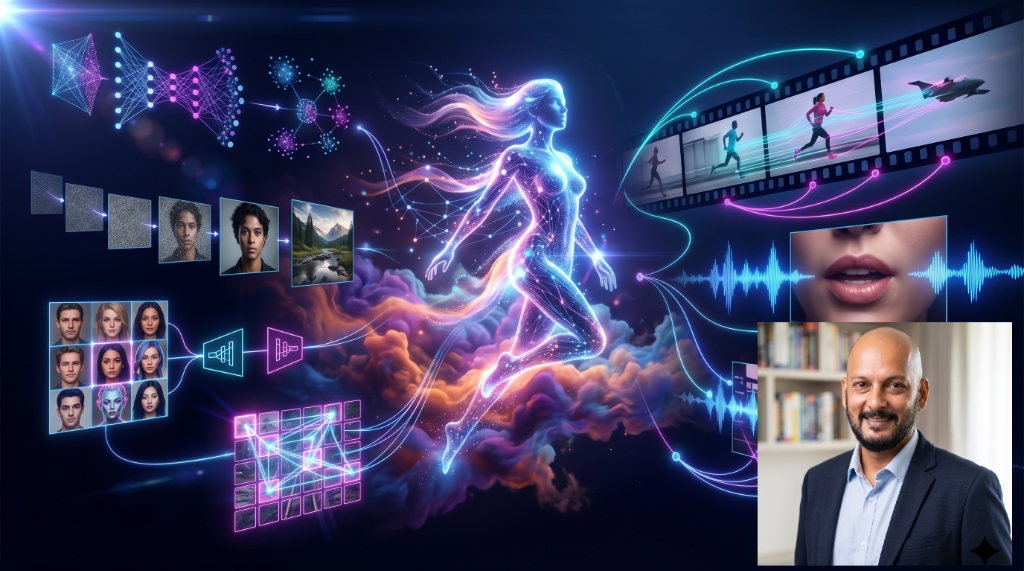
The Generative Vision Family Tree
Explore the complete structural lineage from pixel-space GANs and continuous latent VAEs to rectified flow-matching trajectories and 3D DiTs.
Full high-resolution visual lineage breakdown included in Module 0.
Enroll in Generative Vision & Video
Master generative models from mathematical foundations to production architectures.
Enroll Directly on Udemy
Learn at your own pace with lifetime access to all 28+ hours of DiT theory, 19 code labs, and downloadable repos.
- Deep dive into DDPM, DDIM, SDEs & Rectified Flow Matching
- Patchified Diffusion Transformer (DiT) implementation in PyTorch
- 3D Spatiotemporal video generation (Sora / Wan2.1 architectures)
- Full lifetime access + 19 code labs + Udemy certificate
The Complete Arc — Foundations Through Synchronized Audio-Visual Generation
Comprehensive 5-Module Curriculum with 19 hands-on PyTorch code labs.
- VAEs and the latent-space intuition that underlies Stable Diffusion
- GANs, minimax optimization, and why mode collapse happens
- Vision Transformers (ViT): Patch embeddings and self-attention as the direct prerequisite for DiT
- Continuous vs discrete latent spaces and perceptual loss metrics (LPIPS, FID)
- DDPM through Latent Diffusion Models: Forward noise schedules and reverse denoising networks
- Continuous Normalizing Flows & Rectified Flow Matching (the architecture behind SD3.5 and Flux.1/Flux.2)
- Deterministic ODE solvers vs stochastic SDE samplers
- Classifier-Free Guidance (CFG) math and trajectory stabilization
- Cross-attention conditioning and IP-Adapters for prompt & style fidelity
- ControlNet architectures for structural, pose, and depth conditioning
- Consistency Models & Latent Consistency Model (LCM) distillation (1–4 step inference)
- Adversarial distillation paradigms (SDXL Turbo, Flux Schnell)
- Diffusion Transformers with 3D spacetime patches — the architecture behind Sora, Veo 2, and Gen-3
- Maintaining temporal consistency and resolving frame flickering
- Camera motion control via Plücker coordinates and trajectory embeddings
- Text-to-Video, Image-to-Video, and frame interpolation architectures
- Neural audio synthesis fundamentals (AudioLM, MusicGen)
- Unified audio-visual generation pipelines and cross-modal attention
- Lip-sync architectures (Wav2Lip, SyncNet, landmark conditioning)
- Alignment metrics used to evaluate AV generation (FAD, SyncNet confidence scores)
Generative Vision & Video FAQs
Do I need to already know GANs, VAEs, or Vision Transformers?
No — Module 0 covers exactly this as dedicated foundations before the course moves into diffusion and flow matching. You do need general deep learning / PyTorch experience going in.
Is this about images, video, or both?
Both — and further than that. The course covers image generation (GANs through DiT), full video generation with camera control, and audio-visual synchronization: lip-sync, unified audio-visual models, and the metrics used to evaluate them. Few courses at any price cover the AV-sync layer at all.
How is this different from your Computer Vision course?
Mastering Computer Vision covers discriminative tasks — detection, classification, pixel-level understanding. This course is generative — building models that create images, video, and synchronized audio, not just analyze them.
Vinit Singh
AI Consultant & Principal AI Architect, gadgap AI
Vinit is an AI Consultant and Educator specializing in LLM Fine-Tuning, Voice AI, Speech Language Models, Agentic AI, and Computer Vision — with over 18 years of experience in Data Science and Artificial Intelligence. A graduate of IIT Bombay with Stanford Machine Learning and Deep Learning certifications, he works at the intersection of AI research and real-world deployment.
Currently a Consultant in the Speech & Language team at Sony India Software Centre, his prior work spans Computer Vision on Nvidia edge hardware at Assert AI, and end-to-end AI consulting at tvam Technologies — where he built agentic FinTech workflows, a robo-advisor via LoRA fine-tuning on DeepSeek-R1, and a Voice AI telecaller pipeline.
A top 3% Udemy creator globally, trusted by learners across 150+ countries and enterprises including Adidas, Barclays, and Volkswagen — covering Voice AI, Agentic AI, Computer Vision, and NLP & LLMs.
Enroll in Generative Vision & Video
Buy on Udemy for immediate on-demand access to all 28+ hours of lectures, 19 code labs, and certificate.